
AI Deposition Summaries: What Legal Teams Should Know
February 17, 2026
Technology
What Legal Teams Should Know About AI Deposition Summaries
Key Takeaways
|
Why do AI deposition summaries matter now?
Deposition transcripts are rich in facts and admissions, but the volume and complexity can slow down motion practice and trial preparation. Well‑structured deposition summaries that reference the source transcript help attorneys and in‑house counsel evaluate exposure, prepare cross‑examinations, and draft more confidently because teams can quickly trace key points back to the underlying testimony.Experienced attorneys and judges understand the balance between enhanced efficiency and humility in how it is used. That is the right mindset for AI deposition summaries: AI can accelerate the first pass, but legal teams still need attorney judgment and verification before relying on outputs in strategy or filings.
Legal ethicists urge attorneys to understand both the benefits and risks of generative AI, avoid exposing confidential client information in systems that lack adequate security or clear data use terms, and independently verify AI assisted outputs before relying on them. The American Bar Association similarly frames the duties of competence, confidentiality, supervision, communication, and reasonable billing in the context of AI, making clear that technology does not diminish a lawyer’s professional responsibilities.
When are AI‑assisted deposition summaries most effective?
- Early case assessment and issue mapping. Organizing testimony by elements of claims or defenses allows legal professionals to prioritize follow ups and assess settlement posture quickly, while confirming accuracy through citations and quotes. Judicial commentary supports AI’s potential to make litigation more “just, speedy, and inexpensive,” provided users apply appropriate oversight.
- Witness preparation and cross‑examination. Issue‑based and chronology‑driven summaries help trial teams build outlines, compare testimony across witnesses, and identify inconsistencies, with page‑and‑line support for every point. Ethics guidance consistently emphasizes that attorneys must validate citations, confirm context, and exercise independent judgment before using AI‑assisted analysis in witness preparation or court‑facing work product.
- Motion practice and designations. Citation backed bullets shorten drafting for summary judgment, Daubert, or impeachment designations. Rule 11 of the Federal Rules of Civil Procedure makes clear that the lawyer remains responsible for filings and must ensure candor and accuracy.
How do AI‑assisted summarization work?
Unlike retail-grade AI offerings, legal-specific platforms pair closed-loop large language models with retrieval from the deposition transcripts so that outputs are grounded in source text, not general web knowledge. This can reduce the risk of unsupported statements, but it does not eliminate the need for human validation. Courts have already reacted to unverified AI content, which underscores the importance of a defensible process.What to require in your workflow
- Page‑line citations for every substantive statement
- User interfaces designed with legal applications in mind
- Clear retention, privacy, and access controls that reflect your OCGs and bar guidance on confidentiality and vendor terms
What is the difference between in‑house summarization vs. deposition summary services?
Many firms experiment with general‑purpose legal AI tools or internally built summarization workflows to speed up early deposition review. In practice, this often means pasting transcript excerpts into a consumer chatbot or using lightweight internal scripts to generate first‑pass summaries. While these approaches may appear efficient, they introduce significant risk. Consumer AI tools may retain prompts, lack clear data‑handling controls, and produce outputs that are difficult to audit or defend. Bar authorities have repeatedly cautioned lawyers against using systems that do not provide strong confidentiality protections, transparency into how outputs are generated, and reliable verification mechanisms.Even when firms attempt to control these risks internally, in‑house summarization places a heavy burden on attorneys and staff to supervise outputs, validate page‑and‑line citations, preserve context, and document the process. As deposition volume grows, this manual oversight becomes harder to sustain. In multi‑deponent matters or compressed timelines, small inconsistencies or missed nuances can quickly compound, increasing rework and undermining confidence in the summaries.
This is where legal‑specific deposition summary services differ in a meaningful way. Purpose‑built, enterprise solutions are designed around litigation workflows, ethical obligations, and defensibility from the outset. Rather than relying on consumer-grade tools where data handling may be unclear, these services use closed‑loop environments and configured AI workflows to produce standardized summary formats and transcript‑referenced navigation that support faster review across witnesses.
The result is greater consistency across witnesses, predictable turnaround times, and summaries that are ready to support motion practice, witness preparation, and expert review.
A practical example is Lexitas’ Deposition Insights. The service condenses hours of testimony into multi‑level, citation‑ready summaries delivered in an interactive PDF. Outputs can include high‑level overviews, detailed and topical summaries, page‑line digests, a deposition outline, and visual analysis that highlights key issues and foundational testimony. The linked PDF transcript allows attorneys to move directly from summary to source, which simplifies verification and speeds drafting and impeachment preparation.
For matters that require broader analysis, Deposition Insights+ extends this model across multiple depositions. It supports AI‑assisted queries, cross‑deposition comparison, and automated identification of contradictions and key admissions, while maintaining page‑and‑line traceability. Exhibit‑aware summaries and synchronized video behavioral analysis further support trial strategy, with attorneys retaining full control to validate conclusions before they are relied on in filings or court.
For legal teams evaluating AI deposition summary options, the distinction is less about automation and more about accountability. General or in‑house tools may appear flexible, but they often shift risk back onto the firm. Legal‑grade, managed services reduce that friction by embedding security, verification, and documentation into the workflow, making it easier to explain and defend the process to clients, courts, and insurers in high‑stakes matters.
Practical guidance: prompt structures that improve reliability
Strong prompts reduce noise and drive usable, citation‑backed outputs. Always pair them with human verification. Platforms like Deposition Insights+ are designed to make this process easier by embedding proven prompt logic directly into the workflow.1) Start with a clear role, task, and guardrails
When you prompt an AI tool to help with a deposition summary, be explicit about what you need and how you will use it.In Deposition Insights+, users are guided with built‑in prompt question suggestions that model effective ways to interrogate testimony. These suggested questions give attorneys a strong jumping‑off point for deeper analysis, while also showing examples of how to frame reliable, litigation‑ready questions without having to engineer prompts from scratch.
Whether using a suggested question or asking a custom one, the goal remains the same. Defensible, cited evidence.
Set ground rules to keep the output reliable. In Deposition Insights+, these guardrails are enforced at the system level:
- Every conclusion is drawn only from the uploaded transcript and related case materials
- Summarized answers link back to the source transcript with page and line citations
- Users can click citations to immediately verify context and accuracy
Deposition Insights+ supports this approach by allowing users to ask questions across selected transcripts and uploaded documents, or to limit analysis to specific materials. This preserves context, simplifies fact‑checking, and reflects the caution courts and practitioners expect when AI is used in legal workflows.
2) Always run a final verification pass
Before relying on any AI‑assisted summary for motions, designations, or witness preparation, conduct a short, deliberate quality control review:- Confirm the page and line citation for every summarized point
- Verify that each supporting quote fully supports the stated conclusion
- Flag items that require attorney judgment or strategic context
Common pitfalls to avoid
- Missing or weak citations. Uncited or weakly supported claims are difficult to defend and increase rework. Hundreds of cases with unchecked citations prove the danger of insufficient verification.
- Over‑compression that distorts meaning. Segmenting and synthesizing keep nuance and reduces the risk of losing critical context needed for impeachment or dispositive motions.
- Trusting outputs without validation. Park v. Kim and Kruse v. Karlen demonstrate the risks of relying on unverified AI content. Build a mandatory quality control step into every summary workflow.
- Confidentiality gaps. Ethical guidance warns against inputting client information into tools without adequate security and retention controls. Review terms, disable training on your data, and limit access to need to know.
- Lack of governance. Define roles, risk controls, and documentation across the AI lifecycle. Preserve artifacts that show who ran which prompts and what sources support each output
Security and defensibility checklist
- Data handling: Confirm no training on your data, data segregation, encryption, and deletion timelines in vendor terms. Do not submit client information into tools that lack clear security, retention, and data use controls. Review vendor terms before adoption.
- Court‑facing quality: Maintain attorney quality control and sign off. Ensure that evidence includes page line citations and accurate quotes ready for filings or designations. This meets the practical expectations seen in recent decisions and bar guidance.
Final thoughts
AI assisted deposition summary workflows work best when you set the guardrails. Use structured prompts, require page line citations, run a human verification pass, and align your governance with relevant state and local guidance. With that foundation, legal teams can move from transcript to strategy faster while maintaining the accuracy and accountability courts expect.A final practical point: for this kind of work, legal AI technology is a safer and more defensible choice than general chat tools. Consumer chatbots can learn from or retain prompts, and many are hosted in ways that risk exposing confidential matter data. Legal authorities have warned lawyers not to paste client information into systems that lack adequate security or clear retention and training practices.
By contrast, legal grade tools and services are designed to keep transcripts in restricted environments with explicit rules about data use and deletion, so you are not “uploading your data to the internet” without control.
If you standardize legal‐specific platforms, document your process, and keep attorneys in the loop, AI becomes a responsible accelerator for deposition work rather than a risk.

Related Resources

Articles
Technology
Artificial Intelligence - Complementary Tool or Competitive Threat for Legal Professionals?
The rise of artificial intelligence (AI) within the legal sector presents both challenges and opportunities. As AI technologies become more prevalent, concerns about job security and the future role of legal professionals have surfaced.
Read More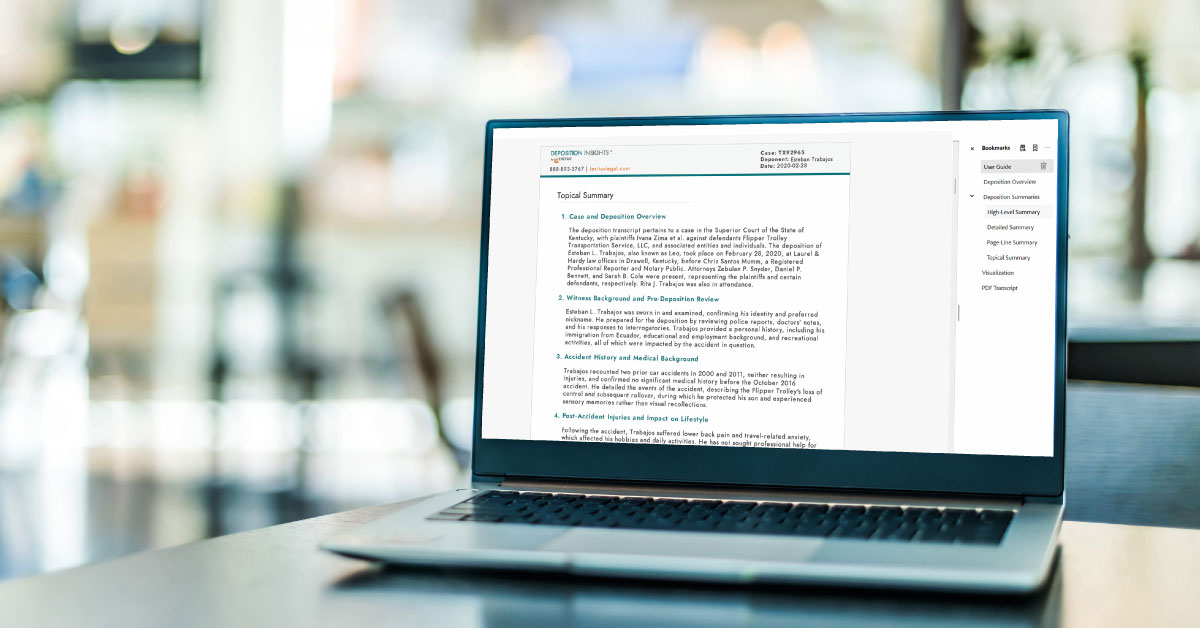
Articles
Technology
How AI Is Transforming Deposition Summaries: Part 2
AI is changing the way legal teams approach deposition review. It is no longer just about creating a simple AI-enabled summary.
Read More
Articles
Technology
The AI Revolution in Law: Reshaping The Legal Landscape
Learn how AI in the legal industry is reshaping legal work, from document review and due diligence to efficiency, training, and new business models.
Read More