
The Deposition Transcript Isn’t What It Used to Be
June 23, 2026
Court Reporting
What Legal Teams Should Know About AI, Summaries, and the Future of Testimony
Key Takeaways
|
What Is a Deposition Transcript and Why Does It Still Matter?
A deposition transcript is still what it has always been: a certified, verbatim record of sworn testimony given during a deposition. It captures every exchange, preserving testimony exactly as it was given. That precision matters. Legal teams rely on transcripts to:
- Uncover the facts of the case
- Support motions and filings
- Preserve testimony for trial
- Identify inconsistencies
- Build and refine case strategy
That foundational role of deposition testimony has not changed. But how legal teams can access, navigate, and apply that record afterward has.
How Is the Deposition Transcript Evolving?
The deposition transcript is evolving from a static, post-proceeding document into a more dynamic, data-driven resource within the litigation workflow.That progress is not driven by technology alone. It reflects a meaningful shift in how legal teams work with testimony, where AI-driven summarization and agentic search expand access to information, but human expertise defines how it is used.
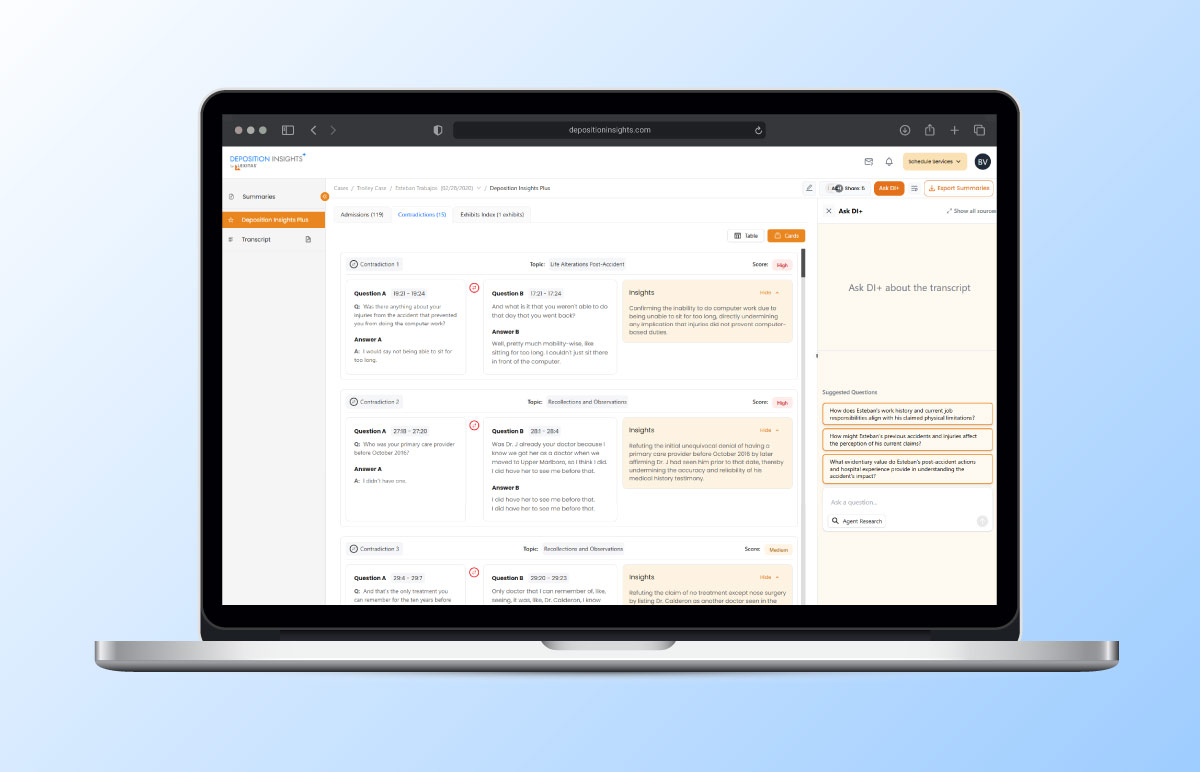
It is evolving into an intelligent, queryable data source, where AI can generate structured summaries, surface key themes, and enable more intuitive, context-aware exploration of testimony across witnesses and matters. Instead of manually locating relevant sections, legal teams can interrogate the record, ask targeted questions and receiving synthesized insights in seconds.
|
In practice, this shift is already taking shape. With solutions like Deposition Insights, AI can condense hours of testimony into multiple summary formats, including high-level overviews, detailed narratives, topical breakdowns, and precise page-line summaries that remain tied to the underlying record. |
 |
But speed is not the end goal. Judgment is.
AI can highlight what may matter, but it cannot determine what does matter in the context of strategy, risk, or legal argument. That responsibility remains with attorneys and legal professionals who validate outputs, interpret nuance, and ensure that every insight is grounded in the official record.
The result is not automation for its own sake. It is a more effective litigation workflow, where AI accelerates access to information through summarization and agentic search, and human expertise ensures that insight is accurate, defensible, and actionable.
In that model, the transcript becomes more than a record. It becomes an active source of intelligence that helps shape how cases are evaluated, prepared, and advanced.
How Is AI Changing the Way Legal Teams Use Deposition Transcripts?
AI is introducing a new layer of functionality to deposition transcripts. Instead of manually reviewing large volumes of testimony, legal teams can now use AI tools to:- Generate summaries of depositions
- Surface key issues and themes
- Search by meaning, not just keywords
- Identify patterns across multiple witnesses
Even as AI accelerates review, attorneys remain responsible for ensuring that summaries accurately reflect the underlying testimony and meet legal standards for use in litigation.
In many cases, these capabilities are supported by platforms like Deposition Insights+, where transcript data is organized into structured summaries and searchable insights that remain tied to the underlying record.
AI helps teams move faster, while human expertise ensures the output is accurate, defensible, and aligned with case strategy.
What Are the Risks of Relying on AI for Deposition Summaries?
While legal AI introduces efficiency, it also raises important considerations. AI tools can generate fast summaries, but if not purpose-built for litigation they may struggle with legal terminology.There are also broader concerns:
- Confidentiality: Some AI tools process or store sensitive data externally, raising privacy risks
- Defensibility: Outputs must be traceable back to the official record
- Ethical obligations: Attorneys are responsible for validating AI-generated content
Certified transcripts, reviewed and verified by qualified experts, remain essential to maintaining the integrity of the record.
How Are Expectations Changing for Turnaround Time and Workflow?
Legal teams are also redefining what “timely” means. Where transcripts once took days to review before meaningful analysis could begin, today’s teams expect much faster access to both content and insight.Common expectations now include:
- Rapid delivery of rough drafts
- Faster turnaround for final transcripts
- Earlier access to summaries and key points
- Integration with litigation support tools
- Reliable formatting
- Consistent structure across transcripts
- Confidence in the accuracy of the record
Why the Deposition Transcript Still Defines the Case
Despite all of these changes, the deposition transcript remains central to litigation. It is still the official record. It is still the foundation for motions, arguments, and trial preparation.What has evolved is how legal teams work with that record. Today, teams are not just reviewing transcripts. They are:
- Identifying key testimony earlier
- Connecting insights across depositions
- Moving more quickly from information to strategy
The modern deposition transcript is not just a document created after the fact. It is a working asset, strengthened by both legal professionals and technology, that helps shape how cases are evaluated, prepared, and advanced.
Related Resources

Articles
Court Reporting
The Deposition Process Explained: A Legal Team’s Guide
Learn what legal professionals need to know about the deposition process, from scheduling and questioning to transcript review and post-depo strategy.
Read More
Articles
Technology
Vendor Due Diligence in the Age of AI
AI is changing legal technology fast. Learn how law firms and legal teams can approach vendor due diligence, evaluate AI legal tools, and reduce risk through accountability, quality controls, and proven workflows.
Read More
Articles
Technology
What Legal Teams Should Know About AI Deposition Summaries
Practical guidance on using AI‑assisted deposition summaries. Learn when they work best, how tools and services differ, ethical and security guardrails, and prompt structures that improve quality.
Read More