
Legal Automation Explained
How AI Is Transforming Practice in 2026
February 4, 2026
Technology
Legal Automation in 2026 Explained
|
A few years ago, legal teams treated AI like a lab project. In 2026, it is part of everyday work. Attorneys use secure, legal‑grade AI tools to draft first passes, accelerate research, summarize depositions, and organize medical records, with lawyers and paralegals reviewing everything before it leaves the building. That is not hype; it matches what the American Bar Association reported for 2024: AI usage among responding lawyers rose to about 30%, up from 11% in 2023. LawSites summary and the ABA Law Practice Division’s TechReport recap of the 2024 data published in 2025 provide the details.
Clients see the shift too. Corporate legal departments expect faster turnarounds, more transparency, and pricing that reflects AI‑enabled productivity. In 2024, a ACC/Everlaw study found that:
- 25% have already reported cost savings.
- 52% showed active GenAI use in the 2025 update.
Why 2026 feels different
This year is a turning point because adoption crossed from “interesting” to “operational,” and client expectations are now explicit. The ABA data shows the near‑tripling of attorney usage (11% to ~30%) and roughly 46% usage at larger firms, which is hard to dismiss as experimentation. Meanwhile, CLOC/Harbor reported that AI adoption in legal departments nearly doubled, with 30% already using AI and 54% planning to adopt within two years, signaling a move to scale.What this means in practice: teams are building repeatable workflows, training policies, and validation steps, rather than running pilots on the side.
How is AI reducing cycle times?
When we say AI reduces “cycle time,” we are talking about the elapsed time from intake to key milestones like drafts, reviews, and filings. Legal automation shortens the idle intervals between those steps (think fewer handoffs and less copy‑paste work) while attorneys remain responsible for analysis, accuracy, and strategy. That is also what clients are signaling when they ask for faster turnarounds and pricing tied to outcomes.How are legal teams using AI today?
- Drafting and research. Lawyers generate a first pass in a trusted, legal‑specific environment, then edit, verify, and cite check. The ABA’s 2024 data ties higher adoption to larger firms and lists the tools most commonly used or considered.
- Summarization and analysis. For hearings and depositions, AI helps create structured summaries, surface entities and issues, and point lawyers to the most relevant testimony earlier. Industry reporting shows a move from pilots to workflow integration in discovery and litigation.
- Discovery market context. Modern platforms increasingly support first‑pass prioritization and concept clustering across emails, chats, audio, and video.
- Will this replace junior roles? Evidence points to a shift in how time is used rather than a replacement of expertise. Professionals expect GenAI to be part of daily workflows, but success comes from policy, training, and measurement that let people spend more time on high‑value analysis and client counseling.
What the ethics rules actually say about AI
The American Bar Association’s Formal Opinion 512 says lawyers who use GenAI must fully consider duties of competence, confidentiality, client communication, supervision, meritorious claims and contentions/candor toward tribunals, and reasonable fees. In short, you must understand the benefits and limits of the tool you choose, verify outputs as needed, protect client information, supervise staff and vendors, be candid with courts, and bill fairly.A few practical highlights from the opinion:
- Competence (Model Rule 1.1). You do not need to be an AI expert, but you must understand how the tool works in your matter, test or validate as appropriate, and never outsource judgment to a tool.
- Confidentiality (Rule 1.6). If the tool could expose client information (for example, certain self‑learning systems), obtain informed client consent. Boilerplate is not enough; explain purpose, data, risks, and benefits, and read the Terms and privacy policies or consult experts.
- Communication (Rule 1.4). Tell clients when AI use is material to decisions, affects fees, or is required by court rules or client guidelines. Engagement letters are a good place to set expectations.
- Candor and meritorious contentions (Rules 3.1, 3.3, 8.4). Verify citations and analysis before filing; courts expect accuracy and candor.
- Supervision (Rules 5.1, 5.3). Set policies, train your teams, and vet vendors for security, confidentiality, conflicts, and incident notice.
- Fees (Rule 1.5). Bill actual time, avoid charging for learning basic tools necessary for competence, and disclose pass‑through per‑ peruse costs where appropriate (drawing on ABA Opinion 93‑379).
Use dedicated legal AI tools, not just general chatbots
General chatbots are fine for brainstorming, but legal work requires legal‑grade systems that support confidentiality, auditability, and sourcing. Industry data shows organizations increasingly adopting enterprise and legal‑specific tools while placing restrictions on consumer chatbots for sensitive workflows. The Lighthouse 2025 benchmark highlights rising enterprise AI adoption and more formal policies around how AI is used.Work with trusted providers who build legal defensibility and transparent sourcing, and make your methods explicit in policies, training, and client communications. For a plain‑English primer and ethical considerations that matter to litigation teams, see our whitepaper on The Ethics of Legal AI in Litigation (terminology, use cases, and common risks).
How are litigation teams using AI right now — and how should firms respond to client expectations?
|
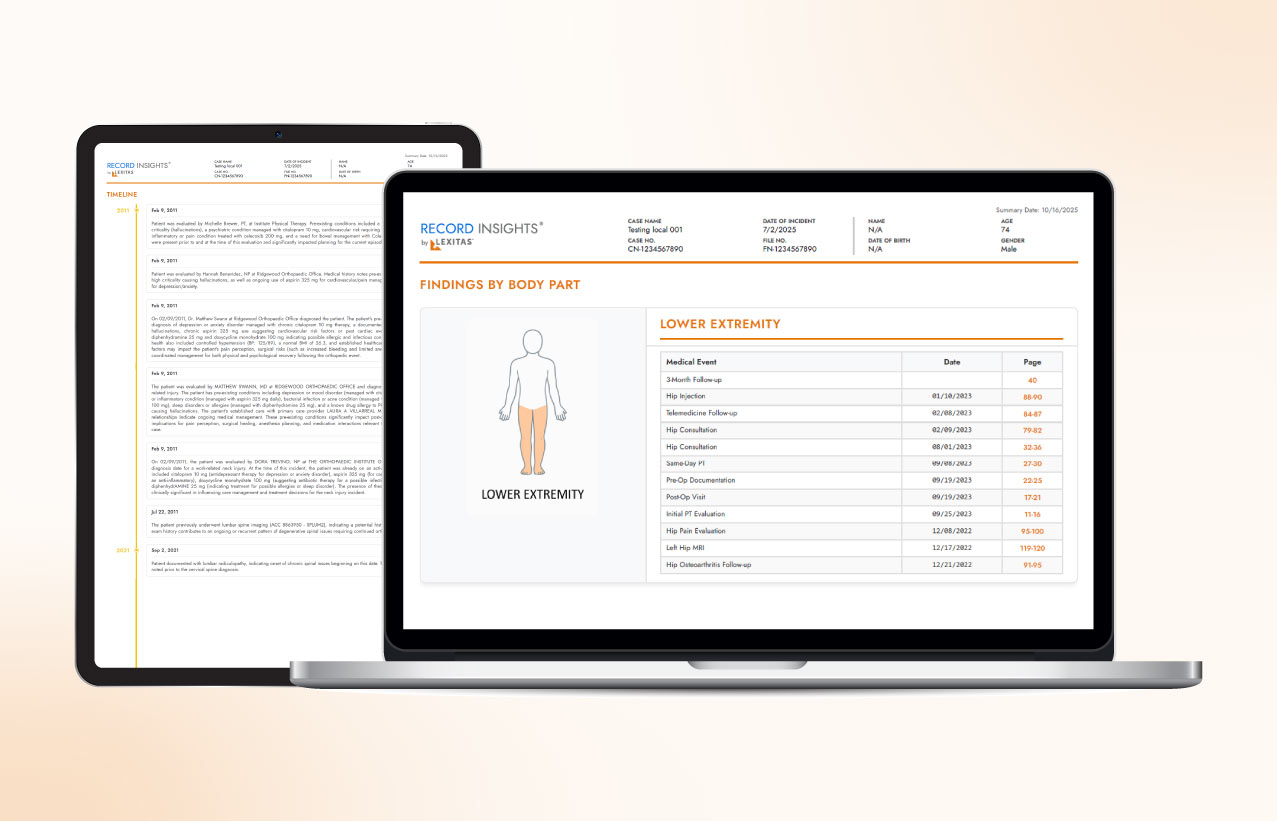
The easiest way to show clients you’re using AI responsibly is to start where it helps most and still keeps lawyers firmly in control: deposition summaries and medical record chronologies.
|
 |
In‑house leaders want evidence that outside counsel uses AI responsibly and productively. The most effective way to address this is to show, not tell: identify where AI supports the work, what remains firmly in attorneys’ hands, how outputs are reviewed and validated, and which metrics you use to confirm quality and turnaround.
For many firms, the clearest path is to start with discrete, high‑value deliverables. Using AI for deposition summaries and medical record chronologies gives clients immediate visibility into how technology improves efficiency without replacing legal judgment. Attorneys still review, edit, and sign off on every output, which makes these workflows easy to explain and defend.
From there, firms can respond to client questions with a simple framework: outline how these tasks are scoped, note the human review steps that occur before anything is shared or filed, and track a small set of practical indicators such as turnaround time or revision rates. Approached this way, AI becomes part of a transparent process that helps attorneys deliver work more efficiently while maintaining professional responsibility and client trust.
Final thoughts
Legal automation in 2026 is practical and present. It helps teams move work forward with fewer bottlenecks and greater accuracy, while lawyers keep control of judgment and quality. The priority is to automate the right tasks, rely on legal‑grade tools, follow ABA Formal Opinion 512, and show clients how your approach translates into faster, more predictable outcomes. As a partner in responsible legal technology adoption, Lexitas provides litigation support built for day‑to‑day work: Deposition Insights™ for testimony and Record Insights® for medical records—solutions designed to fit defensible workflows so attorneys and paralegals can focus on what matters most.Related Resources

Articles
Technology
How Law Firms Can Bridge the Legal AI Expectations Gap with Clients
As legal AI tools become more commonplace, a disconnect is emerging between law firms and their corporate clients.
Read More
Articles
Technology
AI Adoption in Law Firms: Navigating Challenges and Opportunities for Sustainable Growth
For leaders at law firms, the strategic question isn't whether to adopt AI, it's how to harness the advantages of AI effectively to boost your practice today while your competitors are still evaluating their options.
Read More
Articles
Technology
How AI Is Transforming Deposition Summaries: Part 1
Learn how AI transforms deposition summaries into fast, strategic insights—helping legal teams review smarter, reduce costs, and scale across cases.
Read More