
The Hidden Impact of Medical Record Retrieval on Case Outcomes
June 25, 2026
Record Retrieval
The Hidden Impact of Medical Record Retrieval on Cases
Key Takeaways
|
Medical record retrieval is often discussed as a workflow problem. For litigation teams, it is a case outcome problem. Records inform causation, damages, expert opinions, settlement posture, and trial strategy. When retrieval is delayed, incomplete, or poorly documented, the impact is not limited to operations. It changes what attorneys know, when they know it, and how confidently they can act on it.
For seasoned legal teams, the issue is not whether medical records matter. The issue is whether the retrieval and review process gives the team a complete, defensible, and usable foundation early enough to influence strategy.
That is where the hidden impact begins.
Why Does Retrieval Risk Begin Before Review Starts?
The medical record review process begins before the first page is analyzed. It begins with the request.For legal teams, the question is not simply whether records were obtained. It is whether they were obtained through a process that supports admissibility, completeness, and defensibility. Proper authorizations, subpoenas, chain of custody, custodian documentation, provider-specific requirements, and jurisdictional rules all influence whether a record set can withstand scrutiny later.
This is where speed can become misleading. A fast production that lacks the right authorization pathway, custodial support, or documentation may create exposure at the exact moment the team needs the record to hold up. In our article on medical record admissibility risks, we address how admissibility starts at retrieval, especially when records lack proper authorization, chain of custody, authentication, or completeness.
One overlooked area is the misuse of the Patient Right of Access. HIPAA gives patients the right to access their own medical records, but that right should not be treated as a shortcut around litigation-appropriate retrieval methods. Our medical record admissibility resource notes that improper use of Patient Right of Access requests or automated portal scraping may create authentication issues, broken chain of custody, and incomplete productions.
Timing also matters. The U.S. Department of Health and Human Services states that covered entities generally must act on an individual’s access request no later than 30 calendar days after receipt, with a possible additional 30 calendar days when certain written notice requirements are met.
For litigation teams, that timeline is not just administrative. It can affect expert scheduling, settlement evaluation, discovery planning, and early case assessment.
How Do Incomplete Records Change Case Strategy?
Incomplete records do not always look incomplete. They may arrive as a polished PDF, a portal export, or a large production that appears comprehensive. The problem is what may be missing. A legal medical record set may need more than progress notes. Depending on the matter, it may require diagnostic imaging, pathology reports, pharmacy records, billing records, amendments, addenda, audit trails, ancillary provider records, and custodian documentation.Portal-accessed records can omit key components of the legal medical record, including diagnostic imaging or records from ancillary providers. Those gaps do not just slow review. They can shift the evidentiary foundation beneath the case.
An expert may evaluate causation from a partial timeline. A damages model may rely on incomplete billing. A case team may miss prior treatment, intervening events, inconsistent documentation, or gaps in care that would have changed early positioning.
The liability is not only that something was missed. It is that strategic decisions may already be made before the missing information comes to light.
Ready to streamline your medical record retrieval process?
Why Are Digital Records Not Always Review-Ready?
Digitization has improved access, but it has not solved usability. Legal teams still receive records from different providers, portals, systems, departments, and vendors. Files may be duplicative, out of order, poorly labeled, difficult to search, separated from related billing or imaging materials, or delivered in formats that require significant cleanup before meaningful review can begin.
This is one of the most common misconceptions about how medical record retrieval works. Delays and review challenges are rarely caused by a single bottleneck. They are often the cumulative effect of fragmented provider requirements, inconsistent authorization standards, scattered record sources, and productions that were never structured for litigation use.
That matters because experienced legal teams are not simply trying to collect records. They are trying to extract a reliable medical narrative from records that may be technical, inconsistent, handwritten, incomplete, or spread across multiple sources.
When the production is not review-ready, attorneys, paralegals, claims professionals, and experts spend valuable time reconstructing the file before they can evaluate what it means.
How Can AI Make Medical Record Review More Strategic?
|
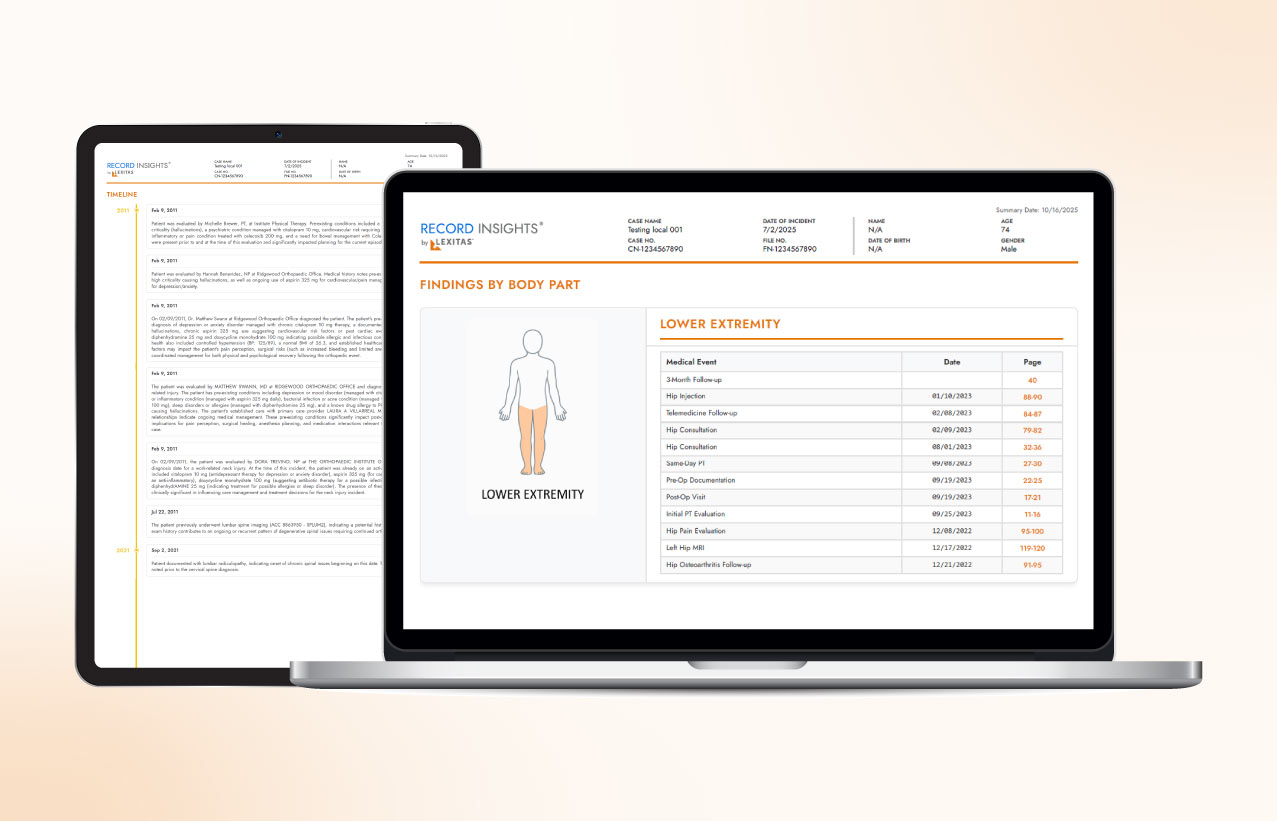
The next evolution in medical record review is not simply faster summarization. It is earlier issue recognition. AI-enabled review is most valuable when it helps legal teams move from document volume to case intelligence. That means surfacing treatment patterns, conditions, medications, provider references, care gaps, diagnostic milestones, and expert-related mentions that might otherwise remain buried until later in the case. |
 |
When Should Law Firms Reconsider an In-House Process?
Many firms can manage retrieval internally when volume is low; providers are limited, and deadlines are flexible. The challenge comes when the work scales.The warning signs are familiar:
- Staff spend more time following up with providers than supporting case strategy.
- Attorneys are waiting on records before they can evaluate exposure.
- Experts receive files that require significant cleanup before review.
- Case teams lack visibility into what is pending, received, or incomplete.
- Records arrive without enough structure to support fast analysis.
The advantage is centralization. A stronger retrieval workflow helps coordinate requests, track status, escalate delays, manage provider variation, and deliver records in more usable formats. When connected to review tools and chronology support, that workflow helps teams move from collection to analysis with fewer gaps.
How Do Structured Retrieval and Review Workflows Improve Outcomes?
A stronger workflow connects retrieval, organization, analysis, and strategy.When records are requested properly, tracked consistently, delivered securely, and organized for review, legal teams gain better visibility earlier in the case. That changes how decisions are made.
A structured medical record review process can help firms:
- Identify missing providers or treatment gaps earlier.
- Support expert review with clearer timelines.
- Reduce manual review time and duplicated effort.
- Improve confidence in causation and damages analysis.
- Locate key medical events, medications, conditions, and provider references faster.
- Reduce risk tied to incomplete or poorly documented records.
Why Does This Approach Matter?
The most effective medical record workflows are not built around retrieval alone. They are built around what the legal team needs the records to do next. A complete record is only valuable if the team can understand it, trust it, and apply it quickly to the case strategy. When retrieval, organization, and review are disconnected, every handoff creates another opportunity for delay, duplication, or missed context.By working with Lexitas, legal teams can bring more structure to that process. Our medical record retrieval services help manage provider complexity, request tracking, follow-up, and secure delivery so internal teams are not pulled away from higher-value case work. For matters where the record volume is large or medically complex, Record Insights® helps extend that value by turning medical records into searchable, AI-enabled chronologies and summaries. Instead of starting with thousands of pages, teams can begin with a clearer view of treatment timelines, conditions, medications, providers, care gaps, and expert-related references.
That combination helps legal teams move from collection to analysis faster. More importantly, it gives attorneys, paralegals, claims professionals, and experts better information earlier, so strategy is shaped by a clearer, more complete view of the medical record.
Final Thoughts
Medical record retrieval is not a side process in litigation. It shapes the quality of information legal teams rely on from the start. When retrieval is fragmented, the consequences show up in delayed evaluations, incomplete expert review, higher costs, weaker strategy, and added admissibility risk. When retrieval and review are structured, visible, and supported by the right technology, records become more than documentation. They become actionable case intelligence.For law firms looking to improve outcomes, the opportunity may begin earlier than expected. It begins with how medical records are retrieved, reviewed, and transformed into strategy.
Related Resources

Articles
Record Retrieval
Are Medical Records Legal Documents and Admissible in Court?
Learn what makes medical records admissible in court and how Lexitas delivers HIPAA-compliant medical record retrieval for litigation success.
Read More
Articles
Record Retrieval
Medical Record Retrieval for Lawyers
A practical guide to medical record retrieval for lawyers, covering discovery timelines, HIPAA compliance, common delays, and how firms maintain control at scale.
Read More
WhitePapers
Record Retrieval
Understanding HIPAA Compliance For Law Firms
In this whitepaper we explore HIPAA, how it applies to law firms, best practices law firms can act on to protect themselves from violations and penalties.
Read More