
Mass Tort vs. Class Action: Discovery & Record Strategy
July 16, 2026
Record Retrieval
Mass Tort vs Class Action
Key Takeaways
|
While both mass tort and class action are designed to handle situations involving large numbers of individuals who allege similar harm, the structure of the litigation affects far more than case management. It influences discovery obligations, evidence collection, medical record strategy, expert review, settlement considerations, and the resources required to move a case forward efficiently.
The distinction is especially important in pharmaceutical litigation, medical device claims, toxic exposure cases, and other complex matters where hundreds or thousands of plaintiffs may be involved but injuries, treatment histories, and damages vary significantly.
Understanding the difference between a mass tort and a class action can help legal professionals build a more effective litigation strategy and prepare for the discovery demands that follow.
Mass Tort vs Class Action – What is the Difference?
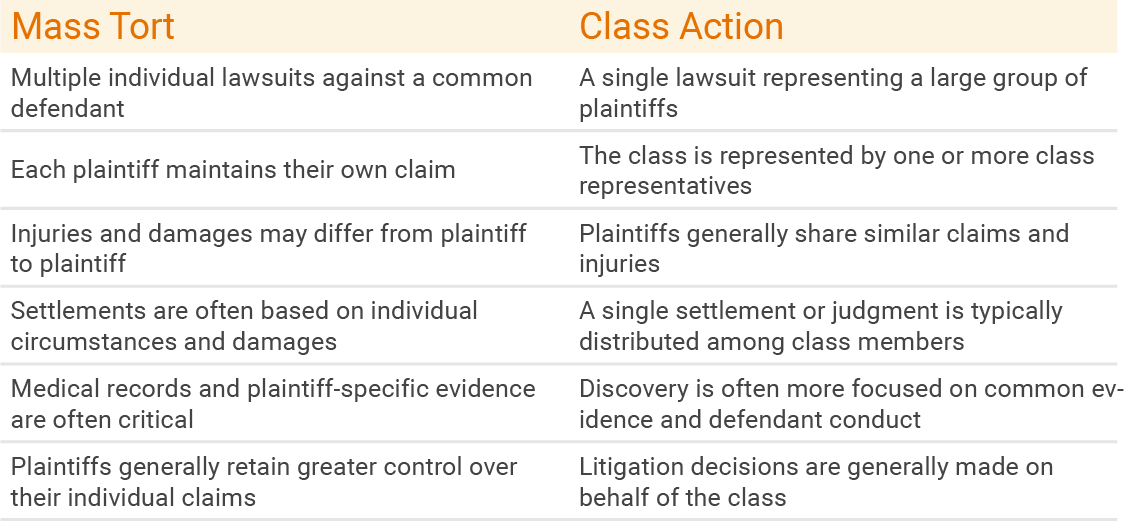
The primary difference between a mass tort and a class action is how individual claims are treated.In a class action, multiple plaintiffs are grouped into a single lawsuit. The claims must share enough common legal and factual issues for the court to certify the class. If the class succeeds, members generally share in a collective resolution.
Mass tort litigation takes a different approach. Plaintiffs may be coordinated for efficiency, but each person retains an individual claim. The court may consolidate certain proceedings or discovery activities, but individual injuries, damages, and settlement values are typically evaluated separately.
The distinction affects nearly every aspect of case strategy, from discovery planning to damages analysis.
When Is a Class Action Typically the Better Fit?
Class actions are generally most effective when plaintiffs have highly similar claims, and damages can be addressed through a common legal framework. Examples may include:
- Consumer protection disputes
- Data breach litigation
- Securities claims
- Product overcharge cases
- Uniform contractual disputes
Rather than evaluating individual medical histories or damages profiles, the litigation often focuses on common evidence concerning the defendant's conduct, policies, or business practices.
When Is Mass Tort Litigation More Appropriate?
Mass tort litigation is frequently used when plaintiffs are exposed to a common product, medication, device, or hazard but experienced different outcomes.Common examples include:
- Pharmaceutical litigation
- Defective medical device claims
- Toxic exposure litigation
- Environmental contamination cases
- Product liability matters involving bodily injury
One plaintiff may require ongoing medical care. Another may experience different symptoms, treatment timelines, or economic losses. As a result, individualized evidence becomes critical.
This is one reason mass tort litigation often generates significantly more discovery complexity than traditional class action litigation.
How Does Litigation Structure Affect Discovery Strategy?
Discovery requirements often become one of the clearest operational differences between class actions and mass torts. In many class actions, discovery centers on common issues, such as:- Corporate policies
- Product design
- Internal communications
- Regulatory compliance
- Defendant decision-making
- Medical records
- Billing records
- Treatment histories
- Pharmacy records
- Employment records
- Expert evaluations
- Damages documentation
This distinction can dramatically increase workload as the number of plaintiffs grows.
Why Do Medical Records Matter More in Mass Tort Litigation?
Medical records often become one of the most important sources of evidence in mass tort matters.To establish causation, damages, injury severity, treatment history, and exposure timelines, legal teams frequently need records from multiple providers for every plaintiff.
A single claimant may require records from:
- Primary care physicians
- Hospitals
- Specialists
- Imaging centers
- Pharmacies
- Surgical facilities
The challenge is not simply obtaining records. Teams must also track authorization forms, monitor provider responses, address follow-up requests, manage delivery timelines, and organize data for attorney and expert review.
What Record Retrieval Challenges Arise in Large-Scale Mass Tort Cases?
As plaintiff volume increases, discovery bottlenecks often emerge. Common challenges include:- Provider Variability: Healthcare providers follow different procedures, timelines, and fee structures for fulfilling requests.
- Response Delays: Even a small percentage of delayed providers can slow production schedules when thousands of requests are outstanding.
- Inconsistent Documentation: Record formats vary widely across healthcare systems, making organization and review more difficult.
- Tracking Complexity: Managing request status, follow-ups, and receipt dates becomes increasingly challenging at scale.
- Review Readiness: Records must often be indexed, organized, and prepared for expert analysis before they become useful case evidence.
How Do Mass Tort and MDL Cases Change Discovery Operations?
The scale of a mass tort or MDL can expose weaknesses in discovery workflows that may never surface in traditional litigation. As plaintiff counts increase, legal teams must manage not only larger volumes of medical records, but also greater complexity in provider outreach, authorization tracking, records review, compliance oversight, and expert preparation.The challenge is not only obtaining records but doing so consistently across an entire plaintiff population. Legal teams need visibility into authorization status, provider response timelines, record completeness, and outstanding requests across potentially hundreds of law firms and thousands of claimants. Without scalable workflows and centralized tracking, discovery delays can quickly compound as new plaintiffs are added and additional providers are identified.
Medical records are often a critical component of proving causation in pharmaceutical, medical device, product liability, toxic exposure, and other complex mass tort matters. As a result, record retrieval becomes far more than an administrative task. It becomes a foundational part of the discovery strategy, supporting plaintiff fact sheets, expert review, settlement evaluations, and case preparation.
As case volume increases, even small inefficiencies can create significant bottlenecks. Challenges such as incomplete provider histories, inconsistent authorization collection, delayed provider responses, and limited visibility into request status become magnified when multiplied across thousands of plaintiffs. Successful mass tort teams often invest in structured workflows, centralized reporting, and scalable retrieval processes to maintain momentum throughout the litigation lifecycle.
|
For example, through our Mass Tort & MDL Services, Lexitas has supported large-scale dockets, including serving as the exclusive record retrieval vendor for the Zantac Products Liability MDL, with an estimated 156,000 plaintiffs. |
 |
One of the more notable aspects of the Zantac MDL was the collaborative approach to record retrieval. By creating a structured workflow that allowed all parties to work from the same medical record set, the litigation reduced duplicative retrieval efforts and helped streamline discovery across a massive plaintiff population.
The experience illustrates an important reality of large-scale mass tort litigation: legal strategy and discovery execution are closely connected. The ability to efficiently retrieve, organize, review, and manage medical evidence at scale can have a meaningful impact on the pace and effectiveness of the litigation.
How Should Legal Teams Prepare for Large-Scale Medical Record Retrieval?
In many mass tort matters, medical records become one of the largest and most time-consuming categories of discovery. A case may involve hundreds or thousands of plaintiffs, each with a unique medical history, treatment timeline, provider network, and damages profile. While the legal theories may be similar across plaintiffs, the evidence rarely is.For that reason, legal teams should view medical record retrieval as a core component of discovery strategy rather than an administrative task. Delays in obtaining records can affect expert review, plaintiff vetting, settlement evaluations, causation analyses, and discovery deadlines.
The challenge becomes more apparent as case volume grows. A single plaintiff may have records from primary care providers, specialists, hospitals, imaging centers, pharmacies, rehabilitation facilities, and other healthcare organizations. Multiply that across hundreds of claimants, and firms can quickly find themselves tracking thousands of record requests simultaneously.
Successful mass tort teams often establish a record strategy early in the case lifecycle. This typically includes:
- Standardized intake procedures for collecting authorizations and provider information
- Consistent workflows for submitting and tracking requests
- Clear quality-control processes for verifying record completeness
- Centralized visibility into request status and outstanding providers
- Systems for organizing records in a way that supports attorney and expert review
The goal is not simply to obtain records. It is to build a repeatable workflow that allows legal teams to manage medical evidence consistently across every claimant while maintaining visibility into progress and outstanding needs.
What Challenges Can Slow Discovery in Large Mass Tort Cases?
One of the most common challenges is provider variability. Healthcare organizations often have different request procedures, fulfillment timelines, portal requirements, and fee structures. Some providers may respond quickly, while others require multiple follow-ups or additional documentation before releasing records.Incomplete provider histories can create additional complications. Plaintiffs may not initially remember every facility involved in their treatment, leading legal teams to discover new providers later in the case. Each newly identified facility introduces another retrieval cycle and can extend review timelines.
The volume of records can also create significant management challenges. Even after records are received, legal teams must determine whether documentation is complete, identify duplicate records, organize materials for review, and prepare evidence for experts and litigation teams.
As cases scale, firms often face additional questions:
- Which plaintiffs are missing critical records?
- Which providers have not responded?
- Which requests are approaching discovery deadlines?
- Which records have been reviewed and analyzed?
- Which plaintiffs have documentation sufficient to support causation arguments?
What Compliance Risks Emerge as Mass Tort Discovery Scales?
Managing large volumes of protected health information also introduces important privacy and compliance considerations. In a mass tort matter, records often move through multiple stages of collection, processing, review, and production while being accessed by attorneys, paralegals, experts, litigation support professionals, and other authorized stakeholders. As the number of plaintiffs grows, maintaining consistent controls around how sensitive information is requested, stored, accessed, and shared becomes increasingly important.Healthcare providers may have different requirements for authorizations, identity verification, and record release procedures, requiring legal teams to manage requests across a broad range of organizations. Missing authorizations, incomplete requests, or inconsistent record-handling practices can create delays, increase administrative burdens, and complicate discovery efforts.
Compliance considerations also extend beyond the law firm itself. When legal teams outsource record retrieval, they are entrusting a third party with access to protected health information (PHI), making vendor due diligence a critical part of the discovery process. HIPAA defines a Business Associate as any outside organization that handles PHI on behalf of another entity, and a compliant relationship should include a Business Associate Agreement (BAA) that clearly outlines permitted uses of PHI, required safeguards, breach notification obligations, and procedures for handling or returning data. However, signing a BAA is only one part of the process. Legal teams must also understand how their vendors manage sensitive data in practice.
A retrieval provider should be able to demonstrate administrative, physical, and technical safeguards designed to protect medical records throughout the retrieval lifecycle. These may include workforce training, documented risk assessments, breach response procedures, secure facilities, role-based access controls, encryption, audit logging, and secure methods for transmitting records. Firms should also understand whether a vendor uses subcontractors, how those third parties are vetted, and whether appropriate agreements and oversight mechanisms are in place.
Selecting a retrieval partner is not simply an operational decision. It is also a risk-management decision. If a vendor lacks appropriate safeguards or experiences a compliance failure, the consequences can extend beyond retrieval delays and administrative challenges. Poor security practices can expose sensitive client information, disrupt discovery workflows, create reputational risk, and increase scrutiny around how medical records are handled throughout the litigation.
As discussed in our article on HIPAA-compliant safeguards for record retrieval partners, legal teams should evaluate not only whether a vendor claims to be compliant, but also whether it can demonstrate the policies, controls, training, and accountability required to support high-volume medical record retrieval.
For large-scale matters, many firms establish standardized record retrieval and management workflows early in the litigation lifecycle. Doing so can help improve visibility into discovery progress, reduce administrative burden, support compliance requirements, and keep case teams focused on strategy rather than records logistics.
How Can Litigation Support Partners Help Manage Discovery Scale?
Mass tort litigation requires legal teams to balance strategic case work with high-volume operational demands. While attorneys focus on liability, causation, and damages arguments, significant resources are often required to gather, track, organize, and manage supporting evidence across a large plaintiff population.This is where litigation support providers can play an important role.
Rather than treating record retrieval as a series of independent requests, dedicated retrieval teams often manage the process as a coordinated workflow. This can provide greater consistency across plaintiffs and improve visibility into case-wide discovery progress.
For legal teams managing substantial plaintiff inventories, a retrieval partner may help:
- Coordinate requests across large provider populations
- Monitor pending and overdue requests
- Standardize follow-up procedures
- Track fulfillment status across hundreds or thousands of requests
- Reduce administrative burden on attorneys and paralegals
- Support review readiness by organizing records for downstream analysis
To address this challenge, many firms are adopting technology-assisted review tools that help transform large volumes of medical records into usable case intelligence. For example, Record Insights® uses natural language processing (NLP) to extract key medical information and create AI-enabled medical chronologies that summarize a claimant's medical history in a clear, chronological format. Rather than sorting through thousands of pages of records, attorneys, experts, and litigation support teams can review a concise chronology that highlights diagnoses, treatments, providers, medications, outcomes, and other significant medical events.
Record Insights® also allows users to search and filter information by medical condition, date, provider, body system, medication, and other key data points through an accompanying Excel export. This can help legal teams quickly identify relevant treatment records, evaluate causation issues, distinguish pre-existing conditions from incident-related injuries, and prepare for expert review, depositions, settlement discussions, or trial.
For large-scale litigation involving significant volumes of medical evidence, the ability to quickly understand what is contained within the records can be as important as obtaining the records themselves. By combining scalable retrieval workflows with AI-enabled medical chronologies, legal teams can reduce review time, improve consistency, accelerate case evaluation, and focus more of their efforts on litigation strategy rather than document management.
How Does Case Structure Influence Litigation Success?
Mass torts and class actions are both valuable tools for managing large-scale litigation, but they are designed to solve different problems.Class actions are typically most effective when claims can be addressed collectively through common evidence and shared outcomes.
Mass tort litigation becomes more appropriate when injuries, damages, and evidence vary from plaintiff to plaintiff. In those cases, discovery planning, medical record strategy, and operational scalability often become critical to case success.
By aligning litigation structure, discovery workflows, medical record strategy, and litigation support resources early, legal teams can reduce bottlenecks, improve visibility into case progress, and better manage the operational demands that often determine the success of large-scale litigation.
FAQs About Mass Tort vs. Class Action Litigation
Is a mass tort the same as a class action?
No. A class action consolidates plaintiffs into a single lawsuit, while mass tort litigation generally preserves individual claims even when cases are coordinated for efficiency.What is the biggest difference between mass tort and class action litigation?
The biggest difference is that mass tort plaintiffs typically maintain individual claims and damages, while class action members generally share a common outcome.Why are medical records important in mass tort litigation?
Medical records help establish injury, causation, treatment history, and damages for each plaintiff, making them a critical component of many mass tort matters.Does discovery work differently in a class action?
Often, yes. Class actions generally focus more heavily on common evidence, while mass tort litigation frequently requires both common and plaintiff-specific discovery.How can legal teams manage large-scale medical record retrieval?
Many firms implement standardized workflows or partner with specialized retrieval providers to manage request volume, provider follow-up, organization, and delivery at scale.Lexitas helps legal teams streamline high-volume record collection, track requests across multiple providers, and maintain visibility into discovery progress across large plaintiff populations.
Related Resources

Articles
Record Retrieval
Navigating the Complex Landscape of PFAS Litigation
The significant litigation that has arisen over the last two decades related to PFAS won’t go on forever, but there’s no doubt that “forever chemicals” are going to remain at the forefront of many legal battles for years to come.
Read More
Articles
Record Retrieval
Unlocking Efficiency in Medical Record Review: How Record Insights® Transforms Case Preparation
In litigation involving medical issues, attorneys often face reviewing thousands of pages of medical records. Record Insights® helps transform the way professionals approach medical chronologies and summaries.
Read More
Articles
Record Retrieval
The Hidden Impact of Medical Record Retrieval on Cases
Learn how medical record review for law firms impacts case timelines, strategy, and outcomes, and why structured retrieval processes reduce uncertainty and improve decision-making.
Read More